Friday, 13 May 2016

Genesis: The Re-evaluation of John - Chapter 9: Wind & Wuthering

The second and final album by the 4-member line-up of Genesis, 'Wind & Wuthering', saw the light of day in the dying days on 1976, just as a new musical tide was about to break over the shores of Britain in the form of the punk revolution. This would not prove to be an ideal time for Progressive music, which was beginning to be seen as 'dinosaur' music, lacking the immediacy and urgency that punk sought to bring (back) to rock music - a fact which would push to the sidelines burgeoning acts such as 'England' and 'National Health'. That being said, this was not a time when sub-standard prog was being written - a month after 'Wind & Wuthering' was released, Pink Floyd unleashed 'Animals' on the waiting world.

Once again the album sleeve was the work of Hipgnosis and Colin Elgie. This time it has a moody, autumnal feel to it, with grey clouds, mists and a single tree towards the lower right-hand corner appearing to be in full leaf. The reverse of the cover, however, shows a huge flock of birds flying away from the now denuded branches - a prophetic foreshadowing of the changes that were to come for the band?

As with 'Trick...' Tony Banks dominates the song-writing credits, with a hand in 6 of the 9 tracks on the disc. Steve Hackett, fresh from recording his first solo album, was a little agrieved that more of his material was not used in the collection, a factor that may well have led to his departure from the band shortly after the tour which followed its release.

Wanting to move away from the mythical inspiration that had fired some of their earlier songs, the band turned to history for the album opener and to the Jacobite risings of the 18th Century. 'Eleventh Earl of Mar' begins with Mellotron chords overlaid with soaring guitar and cymbals, building to a peak as organ and drums pick up the rhythm that drives the song forward. Mike Rutherford's lyrics tell the tale of John Erskine, the eponymous Earl, and the opening lines of the song are also those of the 1925 novel, 'The Flight of the Heron' by Dorothy (D.K.) Broster. The song has a nice pastoral acoustic section mid-way through, which breaks it up quite well.

'One For the Vine' is, perhaps, one of the finest songs that Tony Banks has written, and the fact that he spent over a year honing it may well be a factor in that. It began life in the writing sessions for 'Trick...' and concerns those who put themselves up, or are put up by others, as the Messiah, the Chosen One, and just how fallible they are (or maybe aren't, as the final twist implies). We open with piano and guitar playing a plaintive motif together, before piano takes over as the basis for the song's narrative, with greater orchestration for the second half of the verse. The middle section again is quieter (it may well have been a flute solo in Gabriel's time!), before the opening motif returns, this time heralding what sounds like pots and pans being hit - a prelude to a rockier section dominated by a keyboard solo. The motif returns for a final time taking us into the final verse and the climax of the song. This is perhaps the best the band has played together since Cinema Show, for me.

'Your Own Special Way', by contrast, has always left me a little cold. A solo composition by Mike Rutherford it seems a bit weak and a bit wet, to be honest, but on the plus side it was a stepping stone to songs like 'Snowbound', which is so much more accomplished. Essentially a 12-string guitar song, the verses are played in 3/4 and the chorus and instrumental middle in 4/4. When you consider the material that was left off the album (more on that later), it does seem a little odd that this song was kept in.

'Wot Gorilla?' gives Phil Collins a chance to get his fusion groove on, and Tony Banks an opportunity to develop the keyboard solo from near the end of 'Vine...' a little, as that seems to form the basis for this, the first of the instrumental tracks on the album. The tune bounces along with a playful vibrancy.

'All in a Mouse's Night' is the latest in the comic narrative school of Genesis songs, telling the tale of the perils faced by a mouse in its night-time search for nourishment and its accidental victory over its feline tormentor. The song opens up with strident organ chords which develops into a 'jangly' feel with guitar and keys before a more off-beat section when the mouse is 'talking'. During the periods of jeopardy the rhythm become more uniform (6/8?), and for the dénouement the opening chord sequence returns as the unfortunate cat tries to come out of this sorry business with some shred of dignity still intact.

After the dominance of Tony Banks for much of the album so far, we now come to a section where Steve Hackett is allowed his head. It begins with 'Blood on the Rooftops', possibly the finest song Steve wrote with the band, albeit in collaboration with Phil Collins (who wrote the music to the chorus). It seems to be a song about the place of televison in our lives, and the general tedium of it. Bearing in mind that it was written in the days when there were only 3 channels available to us in the UK it is still remarkably cynical. Musically it is quite beautiful - in contrast to the lyrical cynicism. We begin with classical guitar, which builds to the introduction of the vocals. By the end of verse 1, woodwind and strings (via keyboards) have been included, and the drums only appear for the chorus, along with bass guitar. Simple in structure (verse, verse, chorus, verse, verse, chorus, chorus) this is just an outstanding song by virtue of the musicianship throughout.

The final instrumental section is the paired tracks 'Unquiet Slumber For the Sleepers...' and '...In That Quiet Earth' (which are joined as one track in the US release). The title comes from the final words of Emily Brontë's novel 'Wuthering Heights' (from which the album takes its name). The first part is an atmospheric piece of strumming Spanish guitars with ethereal keyboards overlaid, evoking the mists of the album sleeve. This flows naturally into the secong part, where the band come together with soaring electric guitar, cascading bass and driving drums in 9/8. After some backwards-sounding guitar, the keyboards take up the theme previously played on guitar, and then both guitar & keys pick up a riff from 'Eleventh Earl...' which leads into the final section of the tune, which switches to 4/4 and develops 'Eleventh Earl' riff a little further and jams around it until the song neatly segues into the final song.

If '...Special Way' was Mike Rutherford's love song then 'Afterglow' is Tony Banks's, and whereas he spent 12 months developing '...Vine' this song was written in more or less the time it took to play it, apparently. Relatively simple in its structure there are nevertheless some subtle changes in key throughout the song, and it provides plenty of scope for Phil Collins to exercise his full emotional range in performance. The song quickly became a staple of the band's live shows and continues to be played live by Steve Hackett today.

At the time the album was recorded, the band also laid down some other tunes which came into the public domain later in 1977 as the 'Spot the Pigeon' EP. 'Match of the Day', a peaen to the Birish obsession with football, and 'Pigeons', a song about... pigeons, were suitably throw-away songs, really. But the third song, 'Inside and Out', was something altogether different. a 6½ minute song about a prisoner (most likely someone we would class as a sex offender these days, though apparently stitched up) being released from physical imprisonment, but who was not allowed to escape his past. Both lyrically and musically this is a song of great depth and maturity, and I can't help wondering whether it should've been included at the expense, perhaps, of '...Special Way'. The band clearly liked the song: I've recently heard a live recording of it from the 1977 tour.

But, 'Wind & Wuthering' is what it is. And what it is is maybe the finest work the band has done since 'Selling England...', and in terms of songwriting I don't think they ever reached the heights they did here again. Sadly the making of this album and the subsequent tour was to prove the final straw for Steve Hackett, and by the next time the band came to a studio to record together they would be down to a 3-piece. But the 4-man Genesis left us with two stunning collections of songs, and I for one am grateful that they did.

Wednesday, 4 May 2016

Yes - Sheffield City Hall, 3rd May 2016

Last year (2015) was a difficult one for Yes fans around the world, bringing with it the sad death of founder
and only consistent member of the band, Chris Squire. Many speculated as to whether the band would - or should - continue, but as Chris himself had made contingency plans in appointing Billy Sherwood as his heir in the bass department, the band continue to play, and their current tour reached Sheffield last evening.

In the past 5 years I've seen Yes three times now in the City Hall in Sheffield, each time with a different line-up: the 'Fly From Here' tour, the '3 Album Tour' (Close to the Edge, The Yes Album & Going For The One), and this one. I, like many others, was keen to see how Billy would fit back into the band, and how they would manage to perform some of the material that the two albums on show present.

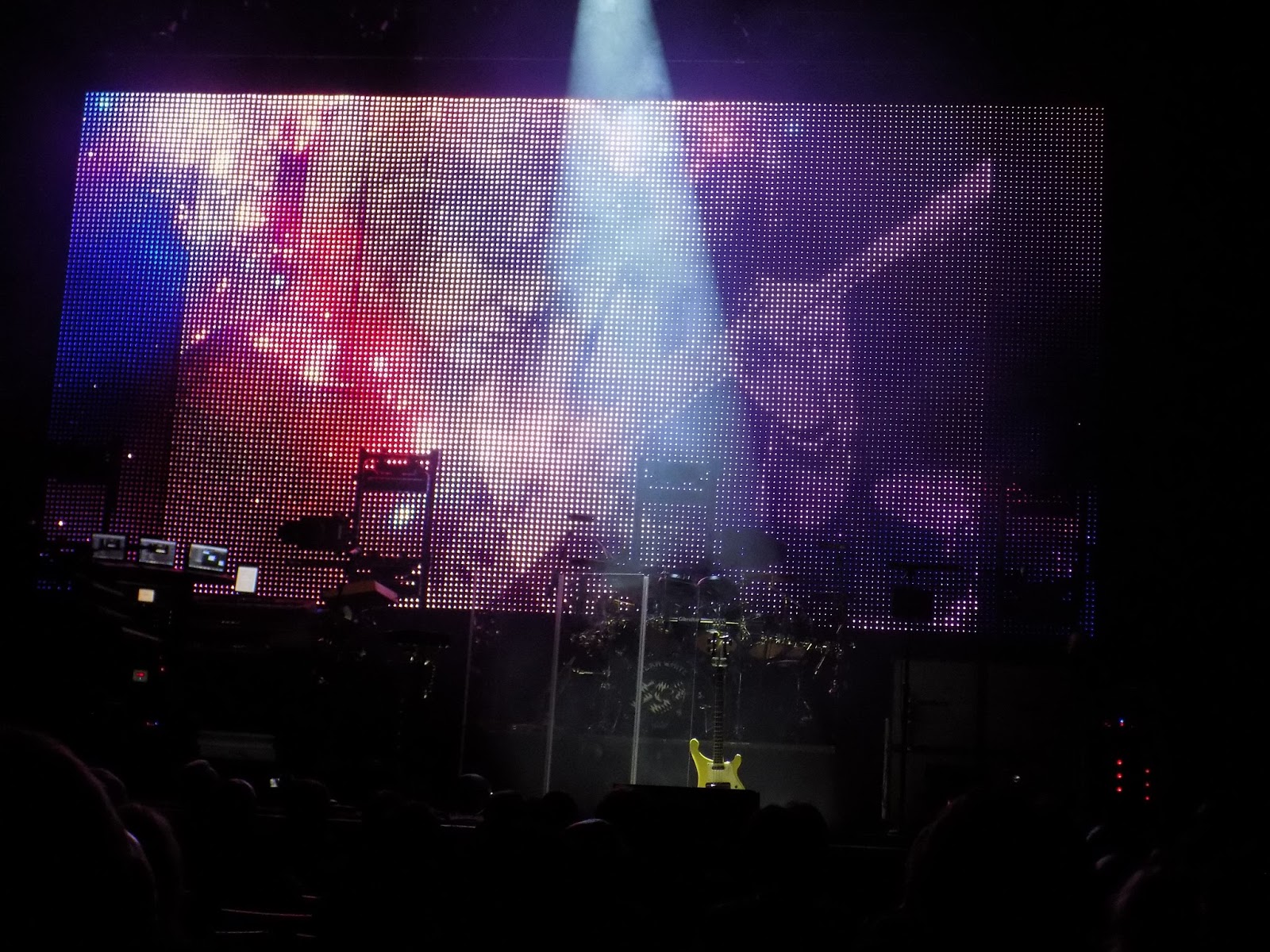
The show began with a moving tribute to Chris: a single spotlight on his cream Rickenbacker bass, centre-stage, as the screen showed a montage of the man and the PA played 'Onward'. Simple, poignant and gut-wrenching. Then into the set proper. 'Drama' is not, I must confess, my favourite from the Yes back catalogue, and I'd listened to it again in the car on the way down to familiarise myself with it again. It is quite a bass-heavy album, which would test Sherwood from the off, and I have to say he did not disappoint.
Billy Sherwood
Technically brilliant throughout the show, he did lack some of the theatricality and bombast of Squire, but if you closed your eyes you could hardly notice the difference. There were, sadly, one or two technical issues for other members of the band, and Jon's voice was struggling in one or two places, I thought. The first half of the set concluded with 'Time and a Word', played as a tribute to Peter Banks, who died in 2013, and 'Siberian Khatru'. During 'Time...' it struck me that none of those performing on stage had played on the studio recording of the song - was this (as some have suggested, following Chris's death) a tribute band?

Following the interval, we began the second half with a couple of hit singles: 'Don't Kill the Whale', and 'Owner of a Lonely Heart'. I must say that Steve looked almost comfortable playing Rabin's guitar parts on 'Owner...' and had the sound down perfectly. Then 'Fragile'. The band numbers, most of which have been live staples for years, came across very well, as did 'The Fish', which Sherwood made his own without losing its iconic nature. 'Mood for a Day' was played perfectly by Steve, and Geoff gave an almost flawless rendition of 'Cans & Brahms'. Even '5% for Nothing' passed muster! Where things came unstuck was 'We Have Heaven', where backing tapes and live performance just didn't mesh at all, and I was left feeling embarrassed for them. Maybe with three singers on stage and some creative use of looping, they could do something better with this material?


Despite my criticisms above, it was a thoroughly enjoyable evening. There is a kind of world-weariness about Steve Howe, but when he's in 'the zone' and gurning away as only he can, he is still a delight to watch and hear. Alan White kept things ticking over, but nothing more really. Geoff Downes was only OK, even on his own material, apart from 'Cans...' which he nailed. Jon Davison seemed quite tired, and that showed in his performance which lacked the spark that I'd seen in him on the last tour. Billy Sherwood was a revelation on bass (which was very prominent in the mix throughout), though not as strong for me on vocals: the Yes Choir was a little lacking.

How long the band will continue, I don't know. There are plans to return to Europe next year to play parts 1&4 of 'Tales from Topographic Oceans', and 2018 would be the band's 50th Anniversary. All good things must come to an end: has Yes's time come? The music will still live on, but how often can the band that plays it change and still be 'Yes'?


Friday, 29 April 2016

Genesis: The Re-evaluation of John - Chapter 8: A Trick of the Tail

The decision of Peter Gabriel to quit Genesis in 1975 came as a huge blow not only to his fellow band members but also to their growing fan base. How would the band respond? For a while a couple of them took some time out and worked on solo and side projects. Steve worked with Phil & Mike and others on his first solo recording, 'Voyage of the Acolyte', while Phil developed his jazz-fusion band, 'Brand X'. But eventually they came back together to begin the next phase of their life as a four-piece with Collins assuming the role of singer and front-man. The first result of this renaissance was 'A Trick of the Tail'.

The album sleeve, another Hypgnosis design, depicts vignettes of the songs on the disc in artwork by Colin Elgie. Also, for the first time, individual song-writing credits are given (previously all songs were credited as band compositions), and it is worth noting that Tony Banks is the only band member with a credit for every song. With Gabriel's departure, it seems as if he has assumed the role of band leader.

That said, the album opens with a group composition, 'Dance on a Volcano', a rocky number written in 7/8 time which features some catchy guitar riffs, soaring keyboard runs, thundering bass pedals and driving drum work. There are echoes here of the work that Collins was doing with Brand X around that time - he'd recorded their debut release just before the band got together to make this album - as well as a music hark-back to 'Back in NYC', which was in a similar time signature. The drumming seems to be more involved than hitherto, as well. The song builds nicely during the instrumental section, before resolving into a typical Genesis sound of 12-strings and organ. A great opener!

In contrast to the bombast of 'Dance...', 'Entangled' is a serene waltz penned principally by Steve Hackett with help from Banks. It evokes feelings of waking from a dream, or more probably from sedation or general anaesthetic, as the lyrics have a medical theme to them. It begins with picked 12-string, which builds as the vocals enter and develops to strummed 12-string by the chorus. By verse 2 the Mellotron makes an appearance, albeit fleetingly, and after the second chorus we move into an extended instrumental section, where keyboards and Mellotron choir contrast the guitars, and there are echoes of 'Ravine' here as the song builds to its crescendo. As far as I can hear, there are no drums and no bass in the song, just 12-strings, keyboards and vocals: but a stunningly beautiful song.

'Squonk', however, hits you straight between the eyes from the off with bass, drums, guitars and keyboards - the full band! But still somewhat gently - there's nothing raucous here. The tale unfolds of the mythical creature, the Squonk, which when captured protects itself by dissolving into a pool of tears - not, perhaps, the most sensible of defence mechanisms - but the song may also be a critique of hunting perhaps. The structure of the song is on the whole quite simple, but the final verse has the feel of something separate, almost tacked on, with quite an abrupt transition.

'Mad Man Moon' has always been the stand-out track on the album for me. Unlike 'Squonk', this is anything but a simple song, in both its structure and its chord sequencing, and demonstrates the start of a distinct change in Banks's writing style. Lyrically poetic and slightly obtuse, it is a song which evokes the British weather but also seeks to make sense of the seeming lunacy of love sometimes. Musically the piano is to the fore, as perhaps one would expect of a Banks composition, with Mellotron & other keyboards evident. What seems to be almost (though not completely) missing is guitars, with Steve's trademark electric soloing only really surfacing in the passage leading into the final verse, and even then only briefly.

So (in old money) we move to side two, and to 'Robbery, Assault and Battery', a song from the school of dramatic and comic story-telling that Genesis made their own in the past with such gems as 'Harold the Barrel' and 'The Battle of Epping Forest', and which gives Phil Collins the opportunity to put his stage school training to good use. Guitars are more to the fore here, particularly during the chorus, but Banks gives himself an extended keyboard solo mid-way through, over some off-beat drumming. And is this the first instance of a (perhaps mild) profanity in the lyrics, when the parentage of the perp is questioned!

The ebb & flow/ light & shade/ loud & quiet of the album continues with the elegiac 'Ripples', a lament for the transient nature of beauty and a collaboration between Banks & Rutherford. 12-strings are again to the fore to begin with, with piano coming alongside by the second half of the verse and the chorus. After the second verse, the piano takes over, with Hackett's guitar singing mutedly over the top and other keyboards picking up a counter melody before the chorus returns to bring the song to its fading conclusion.

I've mentioned in earlier reviews the breadth of inspiration that Genesis have for the subject-matter of their songs, and for the title track, 'A Trick of the Tail', they turn to the writings of William Golding and his 1955 novel 'The Inheritors'. The song, in a quite jovial musical way, explores issues around xenophobia, suspicion and even matters of faith & doubt, and identity. This is another piano-led song, quite jaunty and light, and surprisingly released as a b-side to 'Entangled', where it might have fared better as the lead track. It is maybe the beginnnings of the band developing more along 'pop' lines rather than 'prog', a trajectory that would become more pronounced ovr the next couple of years and beyond.

And so we reach the end of this collection, returning almost full-circle to where we began with 'Los Endos', a band-penned instrumental that drives along at a cracking pace and allows all the band members to show their abilities. As a closing track it picks up a number of themes from earlier songs, notably 'Squonk' and 'Dance on a Volcano', and also (perhaps) wraps up the '(continued)' from the end of the lyric sheet for 'Supper's Ready' on 'Foxtrot' with Phil singing 'there's an angel standing in the sun' a couple of times as the track fades.

This is very mucha transitional album, laying down the benchmark for how the band would develop as a four-piece unit. Phil's drumming is developing as he brings into the band the fruit of his jazzier side-projects; Tony is nurturing a more distinct sound to his compostion; Mike continues to provide the bedrock of the sound with his 12-string, bass and bass padel work; Steve's electric work seems to me to be a little muted in this collection of songs, though this will change in their next venture. But maybe this was the first step on the band's road to becoming the pop-rock superstars that they became in the 1980s.

Wednesday, 13 April 2016

Genesis: The Re-evaluation of John - Chapter 7: The Lamb Lies Down on Broadway

1974 was to be a pivotal year in the life of Genesis, in that it would see the break-up of what we now know as the 'classic line-up' of the band. Much of the reason behind that fracture stemmed from their sixth studio album, 'The Lamb Lies Down on Broadway' and the subsequent tour that accompanied it.

Just as 'Selling England...' had seen a marked shift in the musical direction of the band, so 'The Lamb...' also saw much change (progression?). This was the band's first double album release, clocking in at a mammoth 94 minutes; it was their first foray into the world of the 'concept album', where an overarching theme or narrative embraces the songs throughout the album; and it was the first time that they had used Hipgnosis to design the album sleeve.

The story of the album is another of Peter Gabriel's bizarre, psychological tales (like that on the sleeve notes to 'Genesis Live'), concerning a half-Puerto Rican New York street punk by the name of Rael who embarks on a mysterious journey of self-discovery, which strays into areas of religion, sexuality and consumerism. Lyrically almost all of the songs were penned by Gabriel (the exception being 'The Light Dies Down on Broadway', which is a Banks/ Rutherford work), though he had very little to do with the music on the album, due to other commitments away from the band, apart from 'Carpet Crawlers'.

The story opens with the title track 'The Lamb Lies Down on Broadway', which leads off with cross-handed arpeggios on the piano, building to a crescendo as the vocals enter to tell the story of Rael, with crashing drums and throbbing bass driving the song forward. A keyboard riff that will return later in Carpet Crawlers flows beneath a quieter section, as Hackett's airy guitar cries over the top, before the band picks up again. We segue gently into 'Fly on a Windshield', a studio jam where Steve Hackett comes to the fore (and which still features in his live sets), which itself powers into 'Broadway Melody of 1974', laden with American cultural references, puns and culminating in the line "the children play at home with needles... needles and pins" with the last three words sung to the same notes as in the Nitschze & Bono song of the same name (made famous by The Searchers among others). A gentle, lilting guitar interlude then takes us into 'Cuckoo Cocoon', with some distortion to the vocals, interesting harmonies and picked guitar, with a flute solo midway through. This is very reminiscent musically to me of 'Stagnation' from Trespass in places - nicely nostalgic. 'In The Cage' finds Rael facing up to his predicament, trapped in some subterranean prison and contemplating his future (or possible lack of one). The latent spirituality that inhabits parts of Genesis's music resurfaces as  a 'childhood belief brings a moment's relief. But [his] cynic soon returns and the lifeboat burns.' Here one of the key components of the story emerges, as Raels' brother, John, appears, and we will find him popping up throughout this tale until its startling conclusion. This song races along, driven by Collins' powerful drumming and the counterpoint of Banks's organ, and has within it one of the better keyboard instrumental sections of the band's canon.  And yet another citation (both lyrically and melodically) of a early '60s hit, this time Del Shannon's 'Runaway'.

'The Grand Parade of Lifeless Packaging' has a wonderfully steam-driven, industrial feel to it, with interesting effects on the vocals and an intensity which builds throughout the song. This takes us into 'Back in NYC', a rollicking romp predominantly in 7/8 that takes us far from the latent spirituality of earlier into the beginnings of a baser carnality, both in violence and in sexuality, that will grow as the story proceeds. Gabriel's voice is perhaps at its rawest here, and this song has more recently been covered by the likes of Jeff Buckley and Tin Spirits. 'Hairless Heart' is by contrast a quiet instrumental piece, with lilting keyboard runs and acoustic guitar, leading to a Mellotron solo, and provides a natural link between Back in NYC and 'Counting Out Time', a somewhat comical tale of disastrous sexual experience, which again sees the humour of the band coming out and makes the point that intimate human encounter is more than a mechanical process. 'Carpet Crawlers', the only major musical contribution by Peter Gabriel on the album, begins a sequence where Rael is, along with others, searching for ultimate meaning in life. There is much powerful imagery here: the upward glance, the stairway spiralling out of sight, the wise and foolish virgins (who in Matthew 25 are awaiting the return of the Bridegroom) and the needle's eye winking and closing on the poor (reference to Jesus' assertion about the difficulty of the rich gaining access to the Kingdom of Heaven?). The oft-repeated line "We've got to get in to get out" is almost a mantra by the end of the song, which builds to a stirring crescendo in this desperately beautiful song. That search continues in 'The Chamber of 32 Doors', and carries with it an air of futility that leads to desperation as every avenue simply leads Rael back to where he began - "I need someone to believe in, someone to trust", echoes our hero, but so far to no avail. The song ends with a perceptible musical sigh of despair.

The mood lifts with the advent of 'Lilywhite Lilith', the music excited and hopeful as Rael's blind guide shepherds him out of his endless cycle and leads him into a big round cave where he awaits the next stage of his mysterious adventure. Throughout this album the skills of the five members of the band have been gently augmented by the experimental 'twiddlings' of Brian Eno, but these come to the fore now with 'The Waiting Room', a piece quite unlike anything else in the band's canon: a collection of ambient sounds, tinkling bells, distortion & sound effects that create an air of unreality and suspense, which eventually resolve themselves into a pulsing, rhythmic melody. As Rael is confronted with his own mortality yet again, we move into one of Genesis's (to my mind) most under-rated songs, the sublime 'Anyway'. Starting out light and flowing with piano to the fore, this song builds to an explosion - a rage against the dying of the light? - mid-way through into some of Banks's best piano work outside 'Firth of Fifth', complemented by some almost brassy guitar harmonies, before settling back into its earlier gentle mood. 'Here comes the Supernatural Anaesthetist' is almost an instrumental track, with just a brief vocal section at the start. This is quite a jaunty piece (bearing in mind it's about the approach of death!), with Hackett's guitar riffs providing a strong lead. Instead of finding himself dead, Rael journeys onward through a long passageway to a perfumed pool in which he encounters 'The Lamia', feminine serpentine seductresses who take him to heights of pleasure never known before. The music is quite pastoral throughout, with piano dominant for the greater part of the song, and the echoes of 'Trespass' are quite clear here to me. We move into the sad, elegiac 'Silent Sorrow in Empty Boats', an instrumental dominated by Mellotron choirs and a lilting guitar riff which slowly fades as the lights are dimmed.

The story continues with almost rubbery, playful sounds as we launch into 'The Colony of Slippermen', a three-part tale of the consequences of Rael's romantic encounters with the Lamia. The playfulness continues in the melody, as Rael arrives, wandering 'lonely as a cloud', and encounters the Slippermen, bemused by their appearance until he discovers that he himself is one of them. His only hope is a visit to the Doktor, whose solution to the problem is to 'dock the dick'. Musically & lyrically this section is quite staccato in its feel, with much alliteration. The intensity of the song increases with the arrival of The Raven: the music drives along during the first verse and takes off during the keyboard solo which swoops and soars until the bird pounces and flies off with Rael's tubed member. The song concludes with a reprise of the opening melody as Rael seeks in vain to persuade John to join in in pursuit of the bird, and hurries off only to see the tube drop into the river and disappear. The final instrumental track, 'Ravine', follows: a moody, ambient piece using quiet strumming guitars behind synthesiser sounds of winds and what sounds like a musical saw (which puts me in mind, in a less developed and rhythmic form, of 'Unquiet slumber for the sleepers...' on 1977's 'Wind & Wuthering'), and that takes us into 'The Light Dies Down on Broadway', a slower, more melancholy, minor key version of the opening title track in which Rael contemplates returning to the life he once knew, but is then faced with a counter-choice of saving brother John who is now flailing in the waters below. This dilemma is faced at an even tempo, musically, in contrast to the frenetic pace of earlier, which gives it a kind of dreamy feel. 'Riding the Scree' has a scurrying, urgent feel to it, and as the instrumental section kicks in towards the end it takes on a kind of playful tone - Rael is almost enjoying this! But by the time he hits the water and is 'In The Rapids' the tone is quieter. The strident 12-string chords and the tone of Gabriel's voice here conjure up a chill in the raging waters. There is a quiet desperation in the song, and Gabriel's voice is perhaps at its most soulful than at any other point in his time with the band (as that time comes to its end). The song climaxes as Rael saves John, only to discover that it is in fact himself he has saved!, and the synth's siren wail ushers in the finale - 'it'. What is 'it'? It is what he has been searching for all along, what we all search for but so often can't elucidate: it is identity, it is love, it is intimacy; it is looked for (and found?) in food, in drink, in drugs, in travel, in religion, in sex, in money - in everything and in nothing. Yes, it's only knock and knowall, but I like it!

Genesis's largest studio project, 'The Lamb' has (like many similar concept albums) been held up as a great creative masterpiece, a work of great philosophical and existential exploration and also as a pretentious, over-indulgent, incomprehensible mess. Over 40 years on people still wonder about what the heck it's all about, but you can't deny that it is a piece of musical and lyrical inventiveness and creativity, that still holds its own alongside the other great works of the progressive genre. Perhaps just (just) a little too long, it is, of course, the album that ended the creative partnership of Banks, Collins, Gabriel, Hackett & Rutherford after only four years and four albums. But what a legacy that 'classic' line-up left us!


Saturday, 19 March 2016

Genesis: The Re-evaluation of John - Chapter 6: Selling England By The Pound

Something happened to Progressive music in 1973: a wave of creativity broke over the music scene and the ripples of that tidal surge are still being felt over 40 years later. This was the year that showed us the Dark Side of the Moon, where we feasted on Lark's Tongues in Aspic and performed Brian Salad Surgery whilst living In a Glass House.

Many have speculated as to what was Genesis's finest hour. Was it the epic splendour of Supper's Ready (voted by Progzilla radio recently the favourite prog rock track of all time); was it the tortured and tortuous tale told in The Lamb Lies Down on Broadway; or was it their 1973 album, Selling England By The Pound?

The album certainly marks a quantum leap by the band in terms of musical invention and lyrical creativity, assisted by the broadening of Tony Banks's musical palette with the introduction of an ARP synthesizer alongside the Mellotron & Hammond organ. The band are still telling stories, an enduring and endearing feature of the band's output, and continue to exhibit an abundant virtuosity in their playing. It was the first of their albums to break into the Top 10 in the UK, peaking at number 3, and spawned the band's first hit single, I Know What I Like (In Your Wardrobe), which was itself inspired by the cover art produced this time by Betty Swanwick. In its sequencing, the collection alternates between long and short songs, though whether this was a deliberate move I'm not sure, but as all the long songs are of such high quality it is perhaps good for the listener to have a brief respite between them.

The album opens with 'Dancing With The Moonlit Knight', a song bemoaning the diminution of British uniqueness in contemporary life as transatlantic influences begin to take hold - perhaps prophetic in the McDonaldised, Starbucked, Disneyfied and Wal*Marted towns and cities of today. Like Trespass before it, the opening notes are from Gabriel's voice, with his plaintiff cry: "Can you tell me where my country lies?" Is the 'Queen of Maybe' who answers his call the Disney corporation, I wonder? The opening section is dominated by muted guitar and keyboards, with Gabriel's vocals forceful and clear. A pleasant guitar motif ripples through these early verses, before the Mellotron kicks in in full choir, and as the Knights of the Green Shield begin to stamp and shout the band gets its groove on and  starts to rock! There's already a new, more exciting feel to the music than hitherto: more inventive and playful. The rocky feel fades, and the song ends in a dreamy, meditative passage which (if Wikipedia is to be believed!) was originally meant to segue into Cinema Show, thus creating another 20 minute piece: this was abandoned as an idea, as it was felt that it might be seen as trying to reproduce Supper's Ready.

Instead we move on to 'I Know What I Like (In Your Wardrobe)', which, as I mentioned above, went on to be the band's first hit single, peaking just outside the Top 20. At its heart is a simple 4-note guitar riff which gives the band scope to improvise over the top, and the finished article came out of a studio jam. In later live renditions it leaves room for many of their other songs to be referenced, as well as space for Phil Collins' tambourine tarantella. The lyrics are essentially nonsense, but no less fun for that!

'Firth of Fifth' opens with a blistering solo piano piece from Tony Banks, who shows just what a consummate performer and composer he is: sheer sublime beauty, yet full of energy and panache! As the band come in it feels a little awkward musically as the momentum that has built up seems to falter and the tempo slows. But this song is here to showcase Banks, and after a flute passage from Gabriel we are back to keyboards, first piano then synth, picking up themes from the opening section. This then leads us to Steve Hackett picking up those themes and others with a soaring solo. This is truly breathtaking symphonic music at its finest, rising to a series of crescendi before finding resolution as the vocals return (not quite as awkwardly as previously): it is, to my mind, the band's finest piece of work.

If 'Firth' was essentially a Banks composition, then the next song (although all songs are credited to the whole band) is the work of Mike Rutherford and Phil Collins. 'More Fool Me' gives Collins the opportunity, for only the second time since he joined the band, to take to the microphone as lead vocalist (something he kinda got used to after 1975!). Like 'For Absent Friends', his first (uncredited) venture to the front of the stage, this is a quiet ballad with just 12-string acoustic guitar and vocals, with Phil singing backing voice as well as lead. Like much of Collins' later solo material this is a song about the fragility of human relationships: a kind of anti-love song almost, but nonetheless quite endearing in a slightly treacly kind of way.

The sources of inspiration for Genesis's songs has always been wide and varied, which is part of the band's appeal to many: you never really know what's going to come next! 'The Battle of Epping Forest', the longest track on the album, was inspired by a news story about gang rivalry in the East-End of London. This is a great song, almost in the English music-hall or pantomime tradition with its varied voices, pun-laden lyrics and changes in musical style, and fits nicely alongside 'Harold The Barrel' and 'Get 'Em Out By Friday' from their earlier canon. The battle is followed by a rare instrumental piece (only the second such so far), 'After The Ordeal', a guitar work by Steve Hackett divided between an acoustic section backed by piano, and and electric solo with organ, piano and drums, and flute joining towards the end.

'Cinema Show', the last of the long songs, begins with 12-string guitars backing the vocals, which grows slowly as the rest of the band joins in for the chorus. There then follows an extended instrumental passage with Gabriel providing flute and oboe motifs before more vocal interplay between Gabriel & Collins leads us back to the chorus. Hackett restates the vocal line on electric guitar, before an extended synth solo from Banks builds to a crescendo before gently picking up the guitar motif from 'Dancing With The Moonlit Night' (which this track was originally meant to follow) and leading into 'Aisle of Plenty', effectively a reprise of the opening cut, which suitably book-ends the album.

Thus ends one of the sublimest 53½ minutes of progressive rock ever recorded. It's very difficult to say anything about this album without sounding overly gushing in praise: it's just that good! In the 43 years that have passed since its release little has come close to bettering it in the field, and it continues to grow on me with every listen.